
Last updated: November 2026
Long flights can be exhausting. I get it. Been there got the t-shirt. Have you ever been on a 15-hour international flight and thought you were never gonna get there? It seems to take forever!
Not only do these long flights seem to last forever, but they can be very draining on us physically. How you cope with jet lag plays a significant role in your travel experience on long flights. We can get very tired and irritable, causing us to be irrational and make poor decisions. I have written an article all about jet lag and what you can do to adjust as quickly as possible HERE.
I can go on and on about how long flights can have an effect on us. I have been on hundreds of international flights and experienced these effects first hand. But I know that’s not why you are here. You need to know how to survive these flights and make a long international flight more enjoyable. Fortunately, there are some simple things you can do to help.
What’s the Best Way to Survive a Long Flight?
The best way to survive a long flight is to plan for comfort, sleep and movement before you board. Pick a seat that suits you, wear loose layers, and pack headphones, a travel pillow, an eye mask and solid snacks. Drink water, go easy on alcohol, and get up to walk every so often.
Long Flight Carry-On Checklist
Use this checklist when you pack your carry-on for a long flight. The last column is the rule or catch to watch for with each item.
| Item | Why it helps | Watch out for |
|---|---|---|
| Layers or a light jacket | Cabin temperatures vary, and not every flight hands out blankets | Wear the bulky layer on board to save space in your bag |
| Empty water bottle | Lets you keep drinking water through the flight | TSA limits carry-on liquids to 3.4 oz (100 ml), so fill it after security |
| Solid snacks | A backup if you skip the meal or can’t eat it | Liquid or gel foods over 3.4 oz aren’t allowed in carry-ons; declare food when you enter the U.S. |
| Noise-canceling headphones | Cuts engine noise for movies and sleep | Charge them before you leave home |
| Travel pillow and eye mask | Makes it easier to sleep sitting up | The airline may not hand out pillows at all |
| Compression socks | May lower blood clot risk for higher-risk travelers | Ask your doctor first, since guidelines don’t recommend them for everyone |
| Change of clothes and toiletries | A backup if your checked bag is delayed or lost | Toiletry liquids follow the same 3.4 oz limit |
| Downloaded movies or shows | Entertainment that doesn’t depend on the seatback screen or Wi-Fi | Download them before you leave home |
Tips For Surviving A Long Flight
1. Wear comfortable clothing
As I mentioned in my 13 Air travel tips for first-time flyers post, most airlines will do a great job adjusting the temperature inside the plane to keep it comfortable. Going overseas usually involves very long flights, where you may sleep and sit in the same seat for a long time which is why it is a good idea to wear comfortable clothing. Aside from that, you should also bring a jacket so that you won’t feel cold. Not all flights will have blankets. Proper footwear is also important to stay comfortable both on the plane and walking while boarding or leaving.
If you have extra risk factors for blood clots, ask your doctor about wearing compression socks on the flight. They put gentle pressure on your lower legs to help blood flow back up, and the guidelines the CDC cites recommend them for higher-risk travelers, not for everyone. I cover who should wear them in the health section below.
On my last flight to Tokyo I wore joggers, a T-shirt and a zip-up hoodie, plus slip-on shoes I could kick off once we leveled out. I left the jeans at home and haven’t missed them.
2. Keep entertained
It’s important on a long flight to pass the time away and keep entertained. If you enjoy reading, it is easy to bring a book along with you in your carry on bag.
Many people will bring a tablet or laptop with them on board. You can catch up on some work, watch movies or play games. I don’t recommend all types of tablets for airplanes. Some are better than others due to the size, weight, comfort, etc. The Amazon Fire HD is a great tablet that will work well for most travelers. Download your movies and shows before you leave home so you aren’t counting on the plane’s Wi-Fi or seatback screen.
You will be surprised how fast the time will fly by after watching a few good movies.
3. Bring your headphones
Of course, if you will be watching movies or playing games on your tablet, you will most likely need a pair of headphones. It is nice to enjoy them with no outside noise or distractions. I highly recommend you bring a pair of noise-canceling headphones along with you. I used the Bose QuietComfort 35 for years, and they were amazing! Bose no longer makes them, so if you’re buying a pair today, look at the Bose QuietComfort Ultra Headphones (2nd Gen), which have what Bose calls its best noise cancellation.
I wore my QC35s on a red-eye to London, and once the noise canceling kicked in I couldn’t hear the engine drone at all. It was sooo nice! I slept most of the way and still had battery left when we landed.
You don’t need to break the bank on a quality set of headphones either.
A good budget option is a pair of budget noise-canceling headphones.
4. Select your seat in advance
If you will be going on a long flight, your seat will play a huge role in your overall comfort. You do not want to be stuck in the center seat squished between 2 other people for hours and hours. For me personally, I always select the window seat if possible.
It’s so much easier to lean against the window and get a few more inches of space to get some rest. Some people prefer the aisle seat, as it is easier to get up without bothering anyone plus it guarantees that nobody will be on at least one side of you.
Pro tip:
Try to book the emergency exit row seat for a longer flight. Depending on the plane, the exit row is either over the wing or next to one of the main doors, and it usually comes with lots of leg room so you can stretch out no problem. Keep in mind that FAA rules require exit row passengers to be at least 15 years old and able to open the exit and help others in an emergency, and you can’t sit there if you’re caring for small children. Some airlines also charge extra for these seats. If you fly Delta, here’s how Delta Comfort Plus compares to the exit row.
On a flight to Frankfurt I got an exit row seat next to the door and could stretch my legs all the way out. The spot by the door ran cold, so now I keep a jacket handy when I sit there…
5. Stay hydrated and avoid alcohol

It is very important to stay hydrated on any flight, but more so on longer flights. The air inside a plane is very dry, so drinking lots of water is important.
The CDC notes that alcohol can make you urinate more and can keep you sitting still for longer, so go easy on it. If you plan to sleep, you may want to skip the coffee, tea, and sodas too. The flight attendants will provide water and other drinks, but feel free to bring your own to ensure you get enough liquids. Just remember TSA only allows 3.4 oz (100 ml) of liquid per container through security, so bring an empty bottle to fill up or buy drinks after you’re through the checkpoint.
6. Request an upgrade if possible
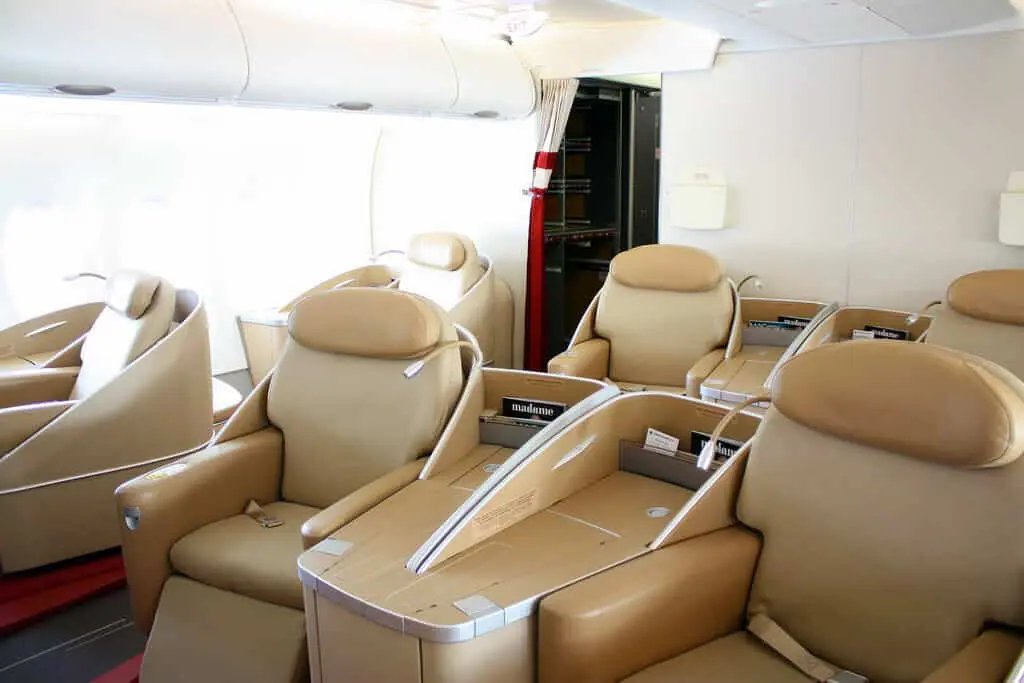
When you are booking your seat, check if a first-class, business-class or premium economy seat might be available. On many long international routes, business class is the top cabin on the plane. You can also ask at the gate prior to boarding or at check-in time. You will most likely have to pay extra but trust me it’s worth it.
If you are a frequent flier, you may have points or credits available for you to use as an upgrade.
7. Bring your own snacks

I learned this lesson the hard way a long time ago. Some people think that you are not allowed to bring drinks or snacks on board the plane. That is not true. You should try to bring healthy snacks like dried fruit, nuts and healthy bars or sandwiches along with you. TSA allows solid food in carry-on and checked bags, but liquid or gel foods over 3.4 oz, like yogurt or hummus, have to go in your checked bag. Here’s more on the rules for bringing food on a plane.
Most long-haul flights will either provide a meal or offer one for purchase. But it’s safe to say that you may want an additional snack or perhaps you don’t like the food on board or have allergies.
So to avoid that problem, bring along some healthy treats to snack on along the way.
One catch on international flights: if you’re landing in the U.S., CBP requires you to declare meats, fruits, vegetables, seeds and other plant or animal products you’re still carrying. Prohibited items you don’t declare get confiscated, and the fine can be up to $1,000 for a first offense. Finish your fruit before you land or declare it. Other countries have their own rules, so check before you fly.
Coming home from Rome, I found a banana I’d forgotten in my backpack and declared it at customs. The officer took it and waved me through, and now I finish any fruit before we start our descent.
8. Exercise
Wait a minute. Exercise on a plane? Yes, there are some things you can do on a plane to get a little bit of exercise. Sitting for hours in one place is not good for anybody. I mentioned earlier about the use of compression socks, which can help blood circulation for travelers at higher risk of blood clots.
You can also periodically get up out of your seat to walk the aisle, stretch and go to the washroom. In your seat, you can do ankle rolls, point and flex your feet, and tighten your calf muscles, which is easy to do. The CDC says frequent walking and calf exercises are reasonable advice for anyone on a long flight.
9. Pack necessities in your carry-on (But don’t overpack)
In the event your checked luggage bags get lost or stolen, it is important to bring some important things with you on board the plane. Things that will get you through like clean clothes and toiletries. Check with your airline to confirm the carry-on bag requirements for weight and size beforehand.
It’s not necessary to bring the largest and heaviest bag possible with you either. Chances are on a long flight, you will need some things in your bag and will be pulling it down from the overhead compartment many times. So keep it light and to a minimum if possible.
10. Bring a travel pillow and eye mask
I can guarantee that the pillow you are issued on the flight will be very uncomfortable. To be honest, I have never seen one that is comfortable. There is also a chance that the airline doesn’t even provide them.
So to be safe and more comfortable, bring your own. They are not expensive and are easy to pack in your carry-on bag. A travel pillow and eye mask will help you rest. There are so many types and styles available, but I recommend you get these. They even include the sleep mask and good ear plugs so you don’t have to buy them separately… Or combine that with some noise canceling headphones and you will really be set. If you want to learn more about noise-canceling headphones check out this article I wrote about them.
11. Be nice
I also mentioned this in a previous post, but it’s appropriate here as well. Unfortunately, I have had the pleasure of working for the airlines and being abused verbally by passengers. It’s too bad because it really is a no win situation for everyone involved.
Being polite to all airline staff will go a long way to ensure you have a pleasant flight. Flight attendants, pilots, and other staff are there for your safety and security and will not tolerate any rudeness or abuse. Some people believe that they can be rude to other passengers or staff members in flight. I have seen it time and time again and not once has it been beneficial to anybody. So please be smart and don’t be rude!
When I worked for the airline, a passenger who stayed calm about a missed connection got rebooked on the next flight out, while the man yelling behind him was still waiting when I went on break.
How to Stay Healthy on a Long Flight
The main health risk on a long flight is a blood clot in the leg, called deep vein thrombosis (DVT). The CDC says the risk is generally low, and most travel-related clots happen in people who already have at least one risk factor.
Risk factors the CDC lists include:
- Older age (the risk goes up after 40)
- Obesity
- Pregnancy or having recently given birth
- Estrogen use, including birth control and hormone replacement therapy
- Recent surgery, hospital stay or injury
- A previous blood clot or a family history of clots
- Active cancer
- Being shorter than 5 ft 3 in or taller than 6 ft 3 in
Everyone can lower their risk by moving. The CDC says walking often and working your calf muscles are reasonable steps on a long flight. It also points to a study where passengers in window seats had twice the clot risk of passengers in aisle seats, probably because it’s easier to get up from the aisle.
If you have risk factors, talk to your doctor about compression socks before you fly. For higher-risk travelers on flights over 6 hours, the American College of Chest Physicians recommends properly fitted below-the-knee stockings with 15 to 30 mmHg of pressure at the ankle (mmHg is how tightly they squeeze). It does not recommend them for travelers without added risk.
Drinking water is still a good idea for comfort, but the CDC says there’s no direct evidence that it prevents clots.
Know the warning signs, because they can show up after you land. The CDC says most travel-related clots happen within the first 1 to 2 weeks after a flight. Pain, swelling, warmth or redness in a leg can mean a clot. Sudden shortness of breath, chest pain, coughing up blood or fainting can mean a clot has reached the lungs, so get medical help right away.
Swollen feet are common on long flights too. Here’s why feet and ankles swell when flying.
Long Flight FAQs
How long is a long flight?
A long flight usually means a flight longer than 4 hours. There’s no official definition, but the CDC notes that researchers most often use more than 4 hours when they study long-distance air travel.
Should I wear compression socks on a long flight?
You should wear compression socks on a long flight if you have extra risk factors for blood clots and your doctor agrees. Guidelines cited by the CDC recommend properly fitted below-the-knee stockings for higher-risk travelers on flights over 6 hours, but not for travelers without added risk.
Can I bring my own food on a long flight?
You can bring your own food on a long flight as long as it’s solid. TSA allows solid food in carry-on and checked bags, but liquid or gel foods over 3.4 oz have to go in your checked bag. If you land in the U.S. from abroad, declare any meat, fruit, vegetables or other plant or animal products you still have.
Is a window or aisle seat better for a long flight?
A window or aisle seat is better for a long flight depending on what you want most. A window seat gives you something to lean on for sleep, while an aisle seat makes it easier to get up and walk, and the CDC notes one study linked aisle seats to a lower blood clot risk.
Thanks for reading!

You May Also Like: